

From Tree to Table
A letter from the family

Every table we bring to Spain and Portugal begins as a tree that stood for decades in the Indonesian sun. This is the story of one of them — a single suar slab we chose by hand, and everything that had to happen before it could stand in your home. It is a long road. We think that is exactly what makes it worth telling.
A tree that drinks the rain

Suar is what we call it in Indonesia; botanists know it as Samanea saman, and much of the world knows it as the rain tree or monkey pod. You will find it across Java, its wide umbrella crown throwing shade over roads, courtyards and rice fields. The name fits: the canopy is so broad that the ground beneath stays cool and green, as if the tree keeps its own small climate.
It is not a forest tree lined up in rows. A suar grows alone, taking all the room it wants, spreading sideways as much as up. That freedom is why the wood ends up with such wild, flowing grain — no two slabs are ever the same.
Wood that takes its time

A young suar grows fast; it can add a metre of height in a single year. But height is not what we are after. We are after girth: a trunk thick enough to give a full tabletop, and thick enough that a leg can flow down from it in one continuous piece.
For a table like this one, with a leg of around eighty centimetres cascading straight out of the top, the trunk has to be at least that wide across. A trunk of eighty centimetres or more does not happen quickly. It takes decades — often forty years or more of standing quietly, season after season, before a tree is ready. When we choose a slab, we are choosing something older than the business itself.
Only a handful from a whole tree

Here is the part people rarely see. A tree that took forty years to grow does not give endless wood. From one mature trunk you get only a handful of full-width slabs — sometimes just a few good ones, once the sawyer has read the log and cut with the grain. The rest becomes smaller pieces, offcuts, firewood. That is why a real single-slab suar table is scarce, and why we can never promise two the same.

Look at a fresh-cut face and you will see two colours. The pale, creamy outer band is the sapwood — the young, living rings near the bark that still carried water up the tree. The deep, chocolate heart in the middle is the older wood, where the tree laid down its strength over the years and let it darken. That contrast is not a defect or a stain. It is the tree’s own timeline, written in colour.
Legal wood, and we can prove it
We only work with certified, legally sourced suar — for every suar piece we sell, without exception. Indonesia runs one of the strictest timber-legality systems in the world: every export is traced from the tree to the container and documented before it may leave the country. It is the system Europe recognises, which is exactly why our wood may enter Spain with its papers in order.
We do not say this to sound official. We say it because a beautiful table should also be an honest one. Knowing where your wood comes from is part of what you are paying for.
The heavy road to Bali

Once the slabs are cut, the journey really starts. The wood is milled on Java, but the finishing happens on Bali, and between the two lies the sea. These slabs are enormous and astonishingly heavy — it takes several men just to lift one onto the truck. They ride across Java, cross by ferry, and reach the workshops on Bali, where the real craft begins. Nothing about moving wood this size is quick or gentle, and every slab arrives with a few honest marks from the trip.
Finished slowly, by hand
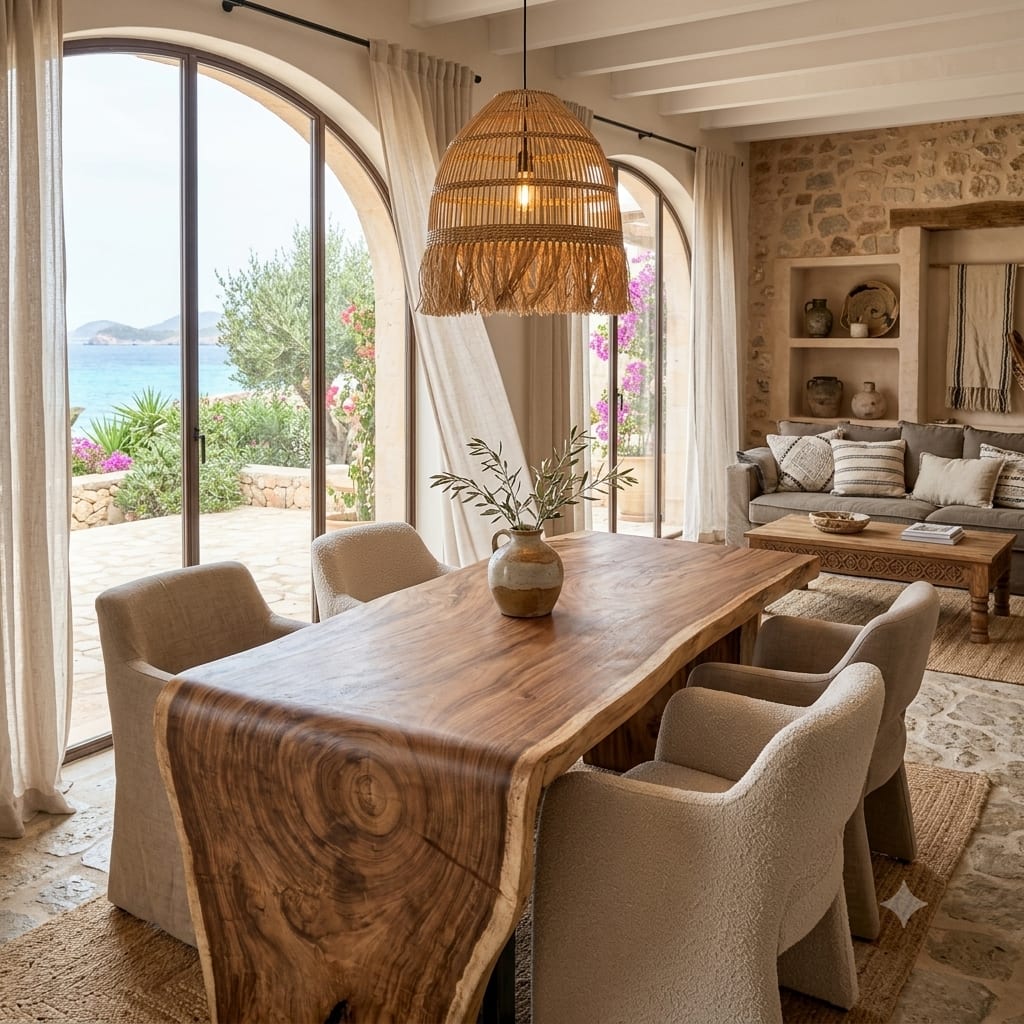
On Bali the slab is flattened and sanded through grit after grit until the grain comes alive, and its natural live edge is kept just as the tree grew it. Then comes the oil — worked in by hand, coat after coat, until the pale sapwood and the dark heart glow side by side. No maker rushes this. The oil feeds the wood, brings out the depth, and leaves a surface you want to run your hand across. It is the moment the slab stops being timber and becomes a table.
Across the sea to Valencia

From Bali the table travels the longest leg of all: weeks at sea in a container, halfway around the world, to the port of Valencia. It is slow, and we would not have it any other way — shipping by sea is how a piece this heavy reaches you without costing the earth. When it finally lands and we open the crate, there is always a small silence. This is the table we chose, months ago and an ocean away, now home.
One table, chosen by hand
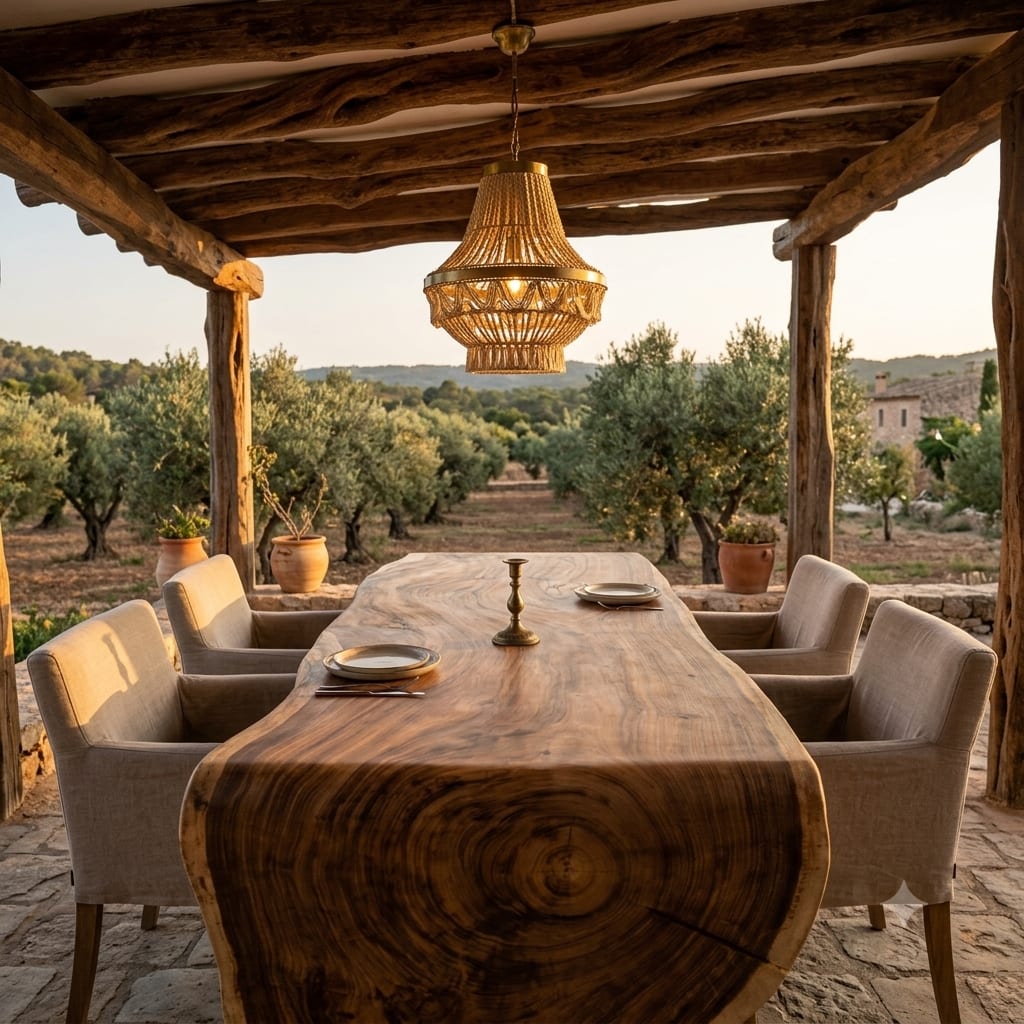
We do not order these by the pallet from a catalogue. We stand in front of the slabs ourselves, in the yards and workshops, and we pick the ones that stop us in our tracks. This one, with its river of dark heartwood down the centre, was one of those. It is genuinely one of a kind. When it stands in your dining room, catching the evening light, it carries all of it with it: the decades in the sun, the sawmill on Java, the hands on Bali, the long crossing to Valencia.
“We are committed to bringing authentic Balinese products to Spain and Portugal. Our team personally visits local families in Bali and selects each piece for its authenticity and the quality of its materials.”
That is the whole road, from a tree drinking the rain to a table under your window. Thank you for caring where your things come from — it is the reason we do this the slow way. If you would like to see the table that inspired this letter, you will find it in our shop.
Warmly, from the Bali family,
Marco, Rick, Ingrid & Lisette

